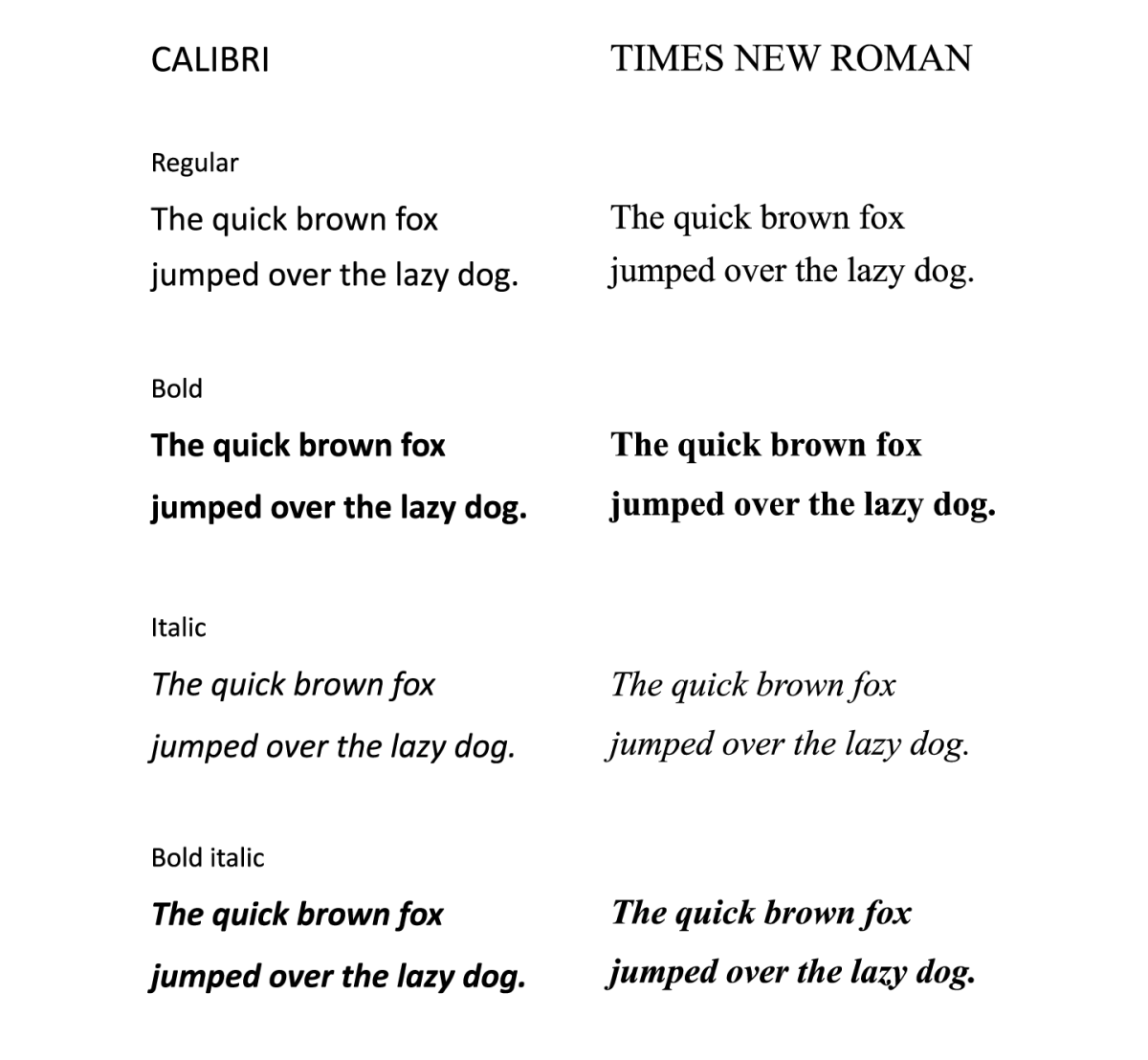
Secretary of State Marco Rubio recently reversed a Biden administration decision (shocker) to use the modern typeface Calibri in all State Department correspondence instead of the traditional Times New Roman. Now, everything is to be released in Times, again.
“Although switching to Calibri was not among the department’s most illegal, immoral, radical or wasteful instances of DEI it was nonetheless cosmetic,” Rubio said in a cable sent to all U.S. embassies and consulates Dec. 9. “Switching to Calibri achieved nothing except the degradation of the department’s correspondence.”
This is not satire.
Rubio, of course, doesn’t give a damn about fonts. Rather, he and the rest of the Trump administration are on a crusade against anything done by the Biden administration. But if we’re willing to look past the partisan politics and focus on typography for a minute, I can understand where both the Biden administration and Rubio are coming from.
Calibri is a sans-serif font, which means it doesn’t have any serifs — the little strokes at the ends of lines in letters (like the lines at the top and bottom of a capital I). Calibri comes across as more user-friendly than Times to a populace that reads less in print and more online, where sans-serif fonts reign supreme. Some studies suggest that sans-serif typefaces are easier for dyslexic readers, which was the Biden administration’s justification for the switch. Other studies have found no discernible difference between san-serif and serif typefaces in this regard.
Times New Roman appears classy, bringing “cohesion, professionalism and formality” to official documents, according to Rubio. It was used by the State Department from 2004 until 2023. Times can also help legibility: Our brains read words as whole units, not as groups of letters, so more traditional serifs like Times’ help improve legibility by subtly joining letterforms to create cohesive entities from letters.
Both of these typefaces are fine, but they’re not great. They both lack a high x-height — the height of lowercase letters (measured with the titular x) relative to the height of a line of text — which makes the text appear larger at small point sizes and has been found to increase legibility more than the presence or absence of serifs.
Georgia was commissioned by Microsoft in the late ’90s to be a serif typeface legible at small point sizes on low-resolution screens. Thanks to its high x-height, it is as effective in print as it is online. Georgia even replaced Times New Roman as The New York Times’ body copy typeface in 2007; The Shakerite followed shortly after — you’re currently reading this story in Georgia.
Georgia is the perfect middle ground of typefaces: It combines the best elements of Calibri and Times New Roman to create a good-looking, designed-for-screens font and adds a high x-height for legibility. If Rubio is truly an appreciator of good typography (which he isn’t) and truly wants the best font for the job (which he doesn’t), then Georgia is hands-down the typeface for him.
That said, the only typeface that would truly match the “cohesion, professionalism and formality” of this State Department is Wingdings.