
Shaker Heights stands out among U. S. cities for its diversity, architecture and commitment to education.
Not to mention its garbage.
“I was very surprised to learn that the residents of Shaker Heights have their trash collected in the front of their garage door, at the corner of their house, or on their driveway. I’ve never heard of a community collecting trash the way it is done in Shaker,” said Assistant Principal Logan Cawley, who joined the high school administration team this year.
For their weekly refuse collection, residents must indeed place garbage in front of their garage door, at the corner of their house or in the driveway. Garbage must be bagged or wrapped, staged outside of fences or enclosures and placed inside containers that have fitted lids made of galvanized metal or weather-resistant plastic.
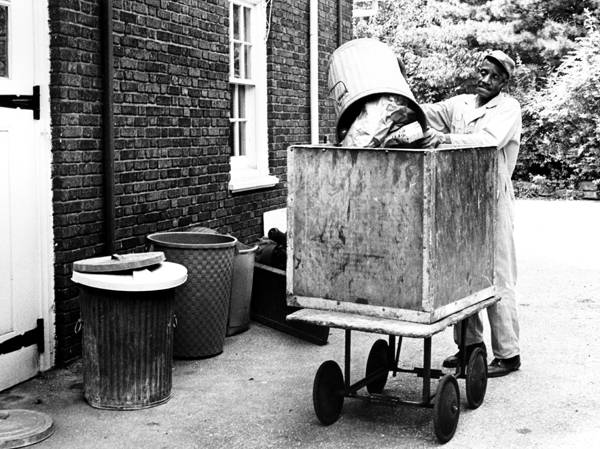
City employees drive small carts up residents’ driveways and dump garbage and recyclables into bins that are attached at the rear of the carts. Once they have gathered the refuse at one address, they drive back down the driveway and onto the street. They drive to the next residence and repeat the process.
When their carts are full, they empty them into a full-size garbage truck parked on the street nearby.
While it’s hard to say how many, or few, U.S. communities practice backyard garbage collection today, it’s safe to say that the practice is rare. A 1997 survey of 100 large U.S. cities by a solid waste consulting firm found that 95 percent of them collected garbage at the curb, and 5 percent provided backyard service.
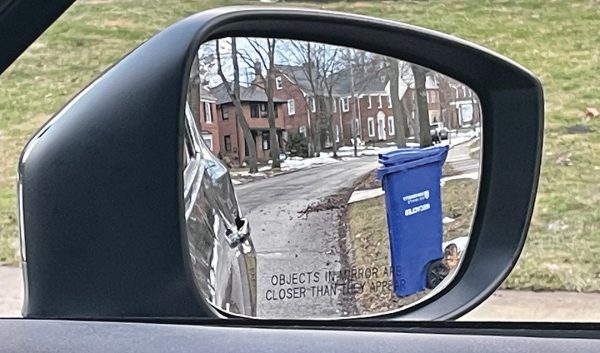
Cawley said that he’s always disposed of trash at the curb. “My lived experience with trash has always involved – and still involves – rolling large bins to the end of my driveway the night before trash pickup, having large trash trucks drive by the next day for pickup, and wheeling said bins back up my driveway the following day,” he said.
Backyard collection requires residents to take some steps to assist employees. First and most importantly, the driveway must be clear of vehicles, snow or any obstacle that would prevent cart access to the garbage. If the driveway is blocked, trash will not be collected. To make sure employees don’t collect non-garbage materials, they must be at least four feet away from trash receptacles.
The backyard policy goes back at least as far as 1960, according to a long-time Shaker Heights resident, and was actually more elaborate than it is today.
In the book “75 Years: An Informal History of Shaker Heights,” published in 1987 by the Shaker Heights Public Library, Bernie Rife, son of long-term Public Works director Rudy Rife, said that city employees used to retrieve garbage from inside residents’ garages until mid-to-late 1970s, when security concerns stopped the practice except for sometimes accommodating sick or elderly residents.
Garbage from Shaker Heights was once accumulated at a service center on Harvard Avenue in Cleveland. Shaker Heights had for decades kept all of its service department trucks, other vehicles and equipment on a five-acre parcel of land on East 173rd Street in Cleveland.
In the early 1960s, nearby Cleveland residents and businesses began complaining to their ward councilman about odors coming from the yard as a result of Shaker Heights using it to store its garbage before disposing of it once and for all.
So the city Service Center was built in the Moreland neighborhood in 1970, which caused the razing or relocation of more than 40 homes in southern Moreland.
Before the 1980s, Shaker Heights used four different crews to pick up newspapers, garbage, leaves and tin cans. As of 2009, Shaker Heights moved grass clippings and leaves to the curb for pick up, which saves the city $104,000 a year.
In 1966, University Heights employees trained in Shaker Heights to learn about backyard collection methods. In 2023, however, University Heights residents voted on whether to continue the practice in their city. Today, University Heights continues to collect garbage manually in backyards, but automated trucks collect recyclables from large, blue, wheeled bins placed on the curb every other week.
The Cleveland Press Collection/Michael Schwartz Library, Cleveland State University
Spanish teacher Kimberly Ponce De Leon said that she appreciates the city’s garbage collection method. “I’ve lived in Shaker for over 34 years, and it’s really convenient, actually. I like it a lot because you don’t have to drag garbage out to the curb or deal with animals on the curb,” she said.
“When I lived in Paraguay, South America, we actually had to literally dig holes in our yards and bury the garbage. So there was no trash collection there,” she said.
Math teacher Walter Slovikovski, who lives in Shaker Heights, said that he wouldn’t mind taking trash to the curb. “But I think if we did, you’d have to help the elderly and those that aren’t as mobile,” he said.“When I first moved here, I saw it as very much a luxury. We took our trash out to the curb at our old community, but it’s very much a luxury.”
However, even though the city spares residents from dragging garbage and recycling cans to and from the curb, some residents are dissatisfied with garbage collection. Recently, Shaker Heights resident Jessica Hensler created a Facebook thread to start a movement for reform. She said the sanitation department leaves leftover trash near her bins.
On the Shaker Heights Community Facebook page, she shared a Google form for residents to detail issues with garbage collection. Hensler said that she created the Google form in response to complaints about garbage removal on Facebook community groups.
“Almost every week, someone would complain on the Facebook community pages about trash not being fully taken,” Hensler said. “I decided to finally do something about it.”
Hensler said that trash is left behind at her home almost every week, including full bags that are not ripped. “I would speak with our trash technicians, and they shared many explanations including ‘The tie for the bag was not on top’ and, one time, ‘The diaper trash is too smelly,’” she said.
“I empathize; the diaper trash is smelly, which is why we need it picked up. Then, when this trash was left, critters would break into it over the next week (despite having lids and bungee cords on the trash cans), and rip open the bags. I then dumped the can into the big contractor bags to collect all the trash that would fall from the ripped bags. Then, the techs wouldn’t take the back bags because they’re not the standard size or they were ‘top heavy’ though they were never full and never over the 40-pound limit, only holding the amount of trash in the acceptable 10-gallon kitchen bag.”
Hensler has lived in Shaker Heights since March 2024. She used to live in Lakewood, which provides once-per-week curbside service to collect household refuse, bulk items, recyclables and yard waste. “I dream of going back to Lakewood nearly every day because the trash and other city services are so subpar from our prior experience,” she said.
Hensler said she has changed her daily habits in response to issues with garbage pickup. “We stopped ordering takeout because it generates too much trash. We host smaller parties because it’s hard to [dispose of] the paper plates and cups afterwards. We don’t recycle because the small buckets are inefficient, and we have seen the technicians not load recycling into the correct side of the truck,” she said.
Hensler, a data and AI product manager and a mother of two, said that she has devoted at least 110 hours to this project. She said that she had a meeting with refuse and recycling personnel and the city administrator, and a meeting with Mayor David Weiss and city administrator about her concerns. Hensler said that Weiss committed to reviewing her requests and responding in 30 days.
In response to Hensler’s concerns, the City’s Chief Administrative Officer Matt Carroll sent an email in which he stated that the city appreciates her efforts and that some of the ideas she raised have already been part of city council discussions in recent meetings.In the email, Carroll wrote that city has researched the costs of increasing the frequency of trash collection, and collecting trash twice a week wouldn’t be financially feasible. He wrote that the city employs 19 people in the refuse division, and that the cost of employees and equipment is close to $1.6 million each year. “A new rubbish truck would cost approximately $425,000, and new scooters are approximately $45,000. Our estimate is that Public Works would need an additional three refuse trucks and nine scooters if a second collection were added, which does not appear to be a viable option,” he wrote.
On March 3, city council held a work session in which they talked about the garbage complaints and improvements to garbage policies.
During the meeting, the city announced that residents may purchase and use recycling bins of up to 18 gallons in capacity rather than the usual five gallons. For the safety of the city public workers the city has asked that residents don’t use recycling bins larger than 18 gallons.
In November 2025, the city authorized the purchase of a multi-hook truck, which will enable workers to pick up bulk items from residences. Currently, residents must take large items to the Service Center themselves, or hire a service to do so. The city estimates that bulk pickup will begin this summer.
The city met with a consultant last year and again recently and is evaluating the best way to use the truck and implement a bulk pick-up program. Service Center bulk drop-off will be maintained.
“During the March 3 work session. I was able to attend and listen in,” said Hensler. “I will say, they kept referring to the problem as ‘my,’ ‘the concerned resident,’ ‘this resident.’ As the survey has 172 different addresses each representing a household of likely two to four people each, I felt like that was an unfair characterization. I feel like this is a bigger problem outside of just ‘my’ personal concern.”
“For now, I think I’m going to let this rest. For now, I think my next focus is going to be on pushing our city to adopt a ‘ward’ style of local government so that each neighborhood has a specific city council representative that they can reach out to,” she said. “This will ensure fair representation of each neighborhood’s concerns and, hopefully, lead to more urgency in addressing those concerns.”