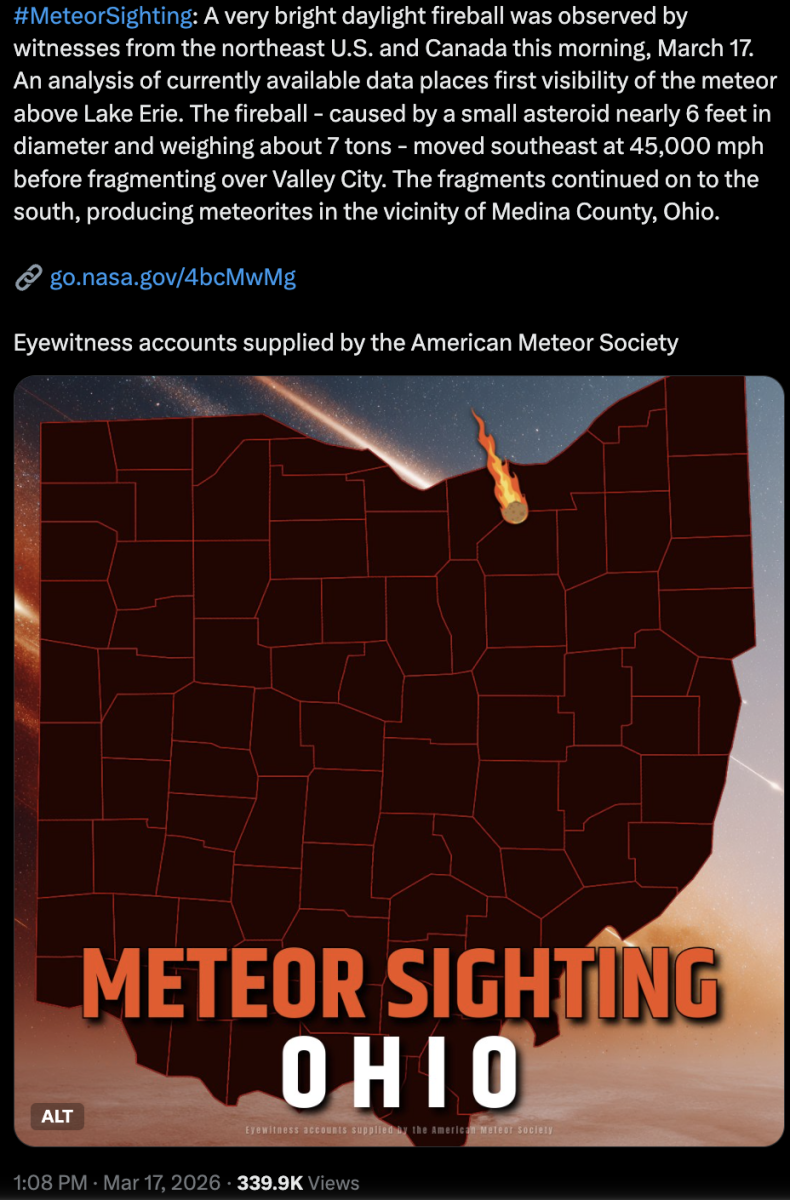
A loud boom heard and felt by students and staff today around 9 a.m. has been traced to a meteor exploding in the atmosphere 27 miles above Lake Erie, according to reports.
NASA reported that the meteor measured nearly six feet in diameter, weighed roughly seven tons and traveled approximately 45,000 mph before disintegrating above Valley City and leaving fragments scattered across Medina County. The resulting explosion was equal to 250 pounds of TNT.
A survey of 26 students found that 10 people heard the sound while 16 did not. Initial theories about its origin ranged from mechanical issues in the building — such as a fume hood malfunction, a burst pipe, roof repair, trash collection, a boiler explosion — to fears of a possible bomb — concerns heightened by the March 4 school lockdown during the in-school ACT administration.
The event was later confirmed by NASA and the American Meteor Society as a “fireball” meteor — an especially bright and fast-moving meteor capable of producing a sonic boom when it breaks apart midair. These meteors travel at extreme speeds and often explode in the atmosphere before ever reaching the ground.
Astronomy teacher Bryan Child said the impact was powerful enough to be felt inside the high school’s windowless planetarium.
“We felt it here,” Child said. “So even with no windows, it was a more powerful one.”
Child explained that meteors like this one typically disintegrate as they enter Earth’s atmosphere.
“When meteors come down, they’re travelling so fast that they start to break down and eventually explode,” he said. “They usually break into smaller pieces, and most of those burn up.”
Because the meteor exploded mid air, it did not create a single large crater. Instead, any surviving fragments would be small and scattered.
“Typically, they break up and leave lots of little craters rather than one big one,” Child said.
He added that a meteor’s composition plays a major role in whether it reaches the ground. “The more rocky they are, the more likely they are to explode. The more metal they are, the more likely they are to survive,” Child said.
He said that this meteor likely contained less metal.
While the boom was noticed in some classrooms, others remained unaware. Social studies teacher Bradley Bullard reported hearing the sound in Room 230, while neighboring math teacher Ryan Routh did not.
Though startling, the event posed no threat to the school community. Still, it left many students and staff shocked, and the brief uncertainty that followed made for a memorable, once-in-a-lifetime moment.
Said Child, “It was just big enough to be heard.”
Journalism II Reporter Arabella Kielbasa and Spotlight Editor Lucas Tcheurekdjian contributed to this report.