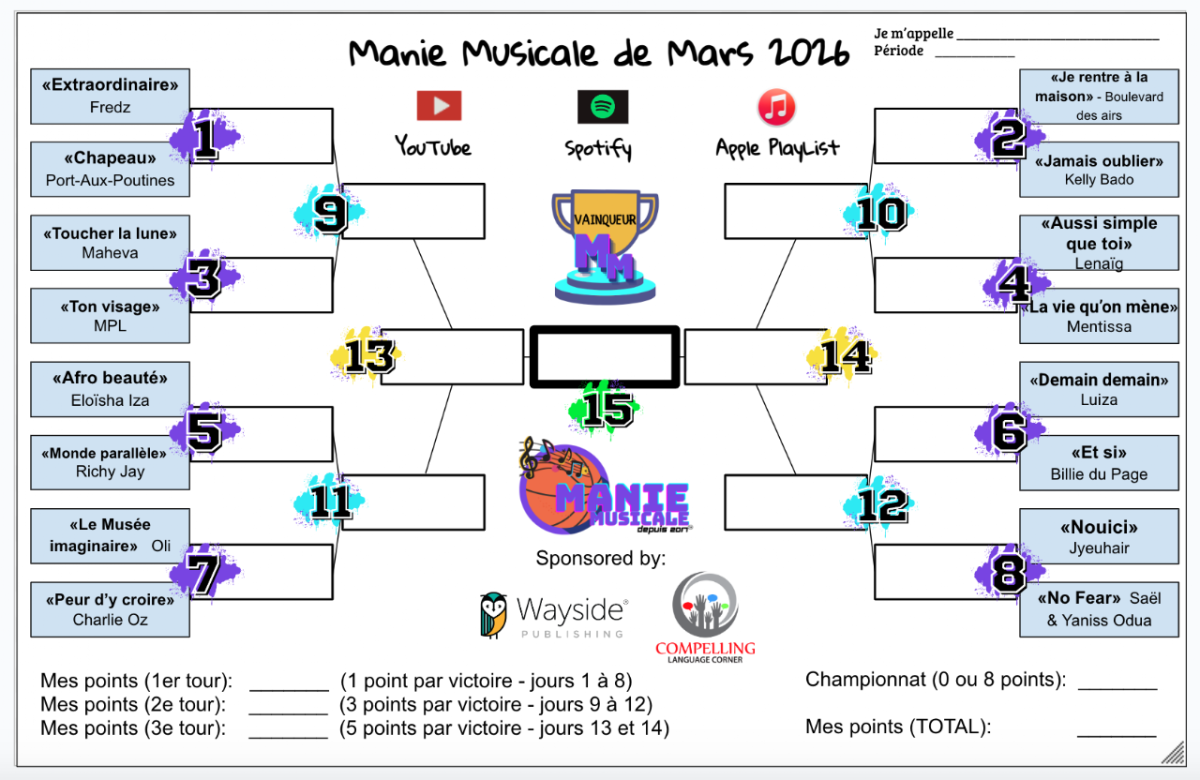
While millions of sports fans across the United States are currently fixated on their basketball brackets and the potential for a “Cinderella story” on the court, a different kind of tournament is capturing the attention of students in the world language hallways of Shaker Heights High School. This competition does not involve free throws or full-court presses. Instead, it relies on catchy choruses, innovative music videos, and the voting power of nearly 1 million students worldwide.
The phenomenon known as Manie Musicale in French classes and Musik Maerz Wahnsinn (MMW) in German classes has officially reached its peak. What began as small, localized classroom activities has evolved into a global cultural event that mirrors the structure of the NCAA March Madness tournament. For sophomore Marios Kallergis, the scale of the event is a major draw. “I think that it’s really cool that MMW is something that so many people do, as it is something that can connect many German learners in the USA,” Kallergis said.
Manie Musicale, the French version of the competition, was founded in 2017 by two teachers in Maine to increase student engagement by introducing them to contemporary Francophone music. They wanted to show students that French is a living, breathing language used by diverse artists across the globe. Sophomore Oscar Robinson said that the event benefited his learning by exposing him to different cultures and niches that are popular to French speakers around the world. Junior Nan Auten agreed. “Manie Musicale immerses and gets us very interested in French not just as a language we learn at school but as more,” said Auten.
Each year, a committee selects songs from artists representing various countries, which are then seeded into a bracket. Students vote in matchups to determine which track advances, often leading to spirited classroom debates. In the German department, students analyzed the modern industry through the MMW bracket. Sophomore Adelaide Davies found that the competition helped her hear the language in different ways as well as helping expose her to authentic German culture. “My classmates and I became aware of how many Turkish and other Middle Eastern immigrants come to Germany,” said Davies. Sophomore Pom Ziv echoed this sentiment. “A bunch of the different songs came from people with different backgrounds who are still German,” said Ziv.
At Shaker Heights, the tournament transforms the daily routine. “This class has made me like French class a lot more, as it gives me something to look forward to every day,” Robinson said. Junior Zachary Moskowitz found the media-rich format helpful for his skills. “Definitely with comprehension, we watch videos and to be able to listen to French… it grabs your attention,” said Moskowitz. However, the academic side can be polarizing. “While it is still fun to come to class, on days where you just write about it the whole time [it] makes it feel boring and repetitive,” said sophomore Andreas Mucha.
As the finals approached, the tension mirrored the real March Madness. Busted brackets were a constant source of conversation. “I did make a bracket, I had Isar winning and Isar did not win. Isar lost by one vote,” Davies said.
“Isar went to the finals but lost… and the fact that it lost is so stupid, and I think it’s outrageous,” Mucha said. ” Kallergis noted controversial upsets. “BAC was absolutely stealing two games from more popular tracks like Gute Laune,” Kallergis said.
Despite the drama of the losses Nan Auten described in the French bracket, the program bridges the gap between the classroom and the real world. For Moskowitz, one of the most significant moments was the history made this year in Manie Musicale: “One thing I’ll remember is that the first female artist ever won this year.”
Sophomore French student Oscar Robinson reflected that the lasting impact isn’t just the music. “But, the memories I made with my classmates when first listening to each song,” Robinson said.