

Efforts to restore heat to high school classrooms caused two fire alarms during second period today, less than 24 hours after five alarms forced two evacuations in 17-degree weather.
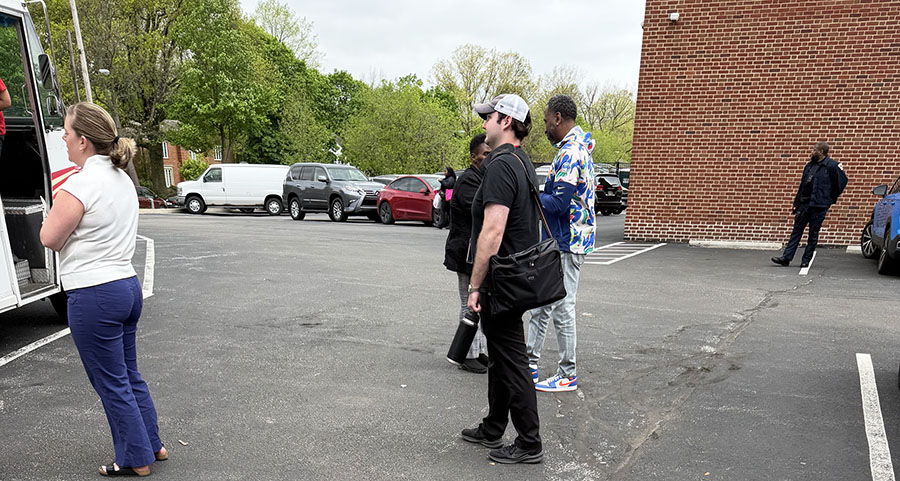
Students and staff were evacuated today at 9:45 a.m. at the first alarm. They were then told shortly after exiting that they could return to the building. Before everyone could re-enter, however, another alarm sounded at 9:49 a.m. and students were met with directions to leave the building, again. The temperature was 19 degrees.
“Today, we experienced issues related to broken heating coils in three classrooms at the high school,” Executive Director of Communications and Engagement Scott Stephens said. According to a 10:46 a.m. email to staff from Principal Isaiah Wyatt, the classrooms were Rooms 163, 158 and 172. “Maintenance is actively isolating the specific coil issue in order to create and implement a repair plan immediately,” he wrote.
Classrooms in the front of the high school have been without heat yesterday and today. English Department Chairwoman Emily Shrestha described a variety of classroom temperatures this morning.“Right now Room 153 is frigid, 154 and 155 are blazing hot,” she said. Teachers in Rooms 154 and 155 had to open windows because the classrooms were so hot, she said.
Room “159 is comfortable, but 158 is a meat locker. 162 and 163 are also freezing, but 161 is quite comfortable,” she said.
Ice had formed in the non-functioning heating unit in Room 163. When maintenance workers began working on it, a pipe failed and released hot liquid, which met the ice and created steam. The steam triggered the fire alarm.
Principal Isaiah Wyatt made an announcement to students at 10:41 a.m. that the alarm system was being manually monitored and that future alarms should be ignored unless a P.A. announcement was made ordering an evacuation.
The five alarms and two evacuations that occurred yesterday were unrelated to heat failure and were the result of a faulty sensor, which was repaired. Today’s episode was the second evacuation due to steam caused by a failing fixture since Sept. 25, 2024, when the school evacuated into a heavy rain after steam from a burst hot water pipe triggered the alarm system.
Senior Ricki Hawari said these issues happen too often. “All I was thinking was, like, why can’t the administration get it together? It seems every quarter, there’s a problem that affects the schedule. I’m tired of the interruptions. It threw off my whole day,” she said.
Sophomore Anna Kaminski said the school needs to do better with fixing these problems. “There’s definitely things that are preventable. Obviously, there are gonna be pipes that burst. There are gonna be things that malfunction, but the thing that matters most is what you do. I mean, you can’t keep a building as old as this one in perfect working condition. You have to do maintenance. You have to keep up with it,” she said.
Sophomore Casiana Glover said the evacuations are dangerous. “I was slipping in the hallways. The floor was disgusting. It was horrible. I honestly thought I was going to freeze to death, like seriously,” she said.
She also said communication about whether to re-enter or go back outside was difficult. “Nobody can hear you on the announcements while there’s people screaming in the hallways,” she said.
Senior Danya Swain was confused by the communication to students. “We finally got to our friend’s car, and as soon as we got in the car, we couldn’t even get warm, because a second later, we had to go back in. And then we had to come back out and go sit in the car again for a minute and then come back out again. It’s such a hassle. You’d think from yesterday they’d have this problem fixed. Why are you making us do this? Let us stay home,” she said.
The classrooms without heat are all located in the high school’s front hallway. Students and teachers are struggling to focus and teach in rooms with temperatures in the 50s.
English teacher Aimee Grey said that the conditions were unbearable. “I relocated my ninth-period class into the library because my classroom, 161, was extremely cold,” she said. Instead of producing heat, the unit in Room 161 pumps in cold air directly from outdoors, she said.
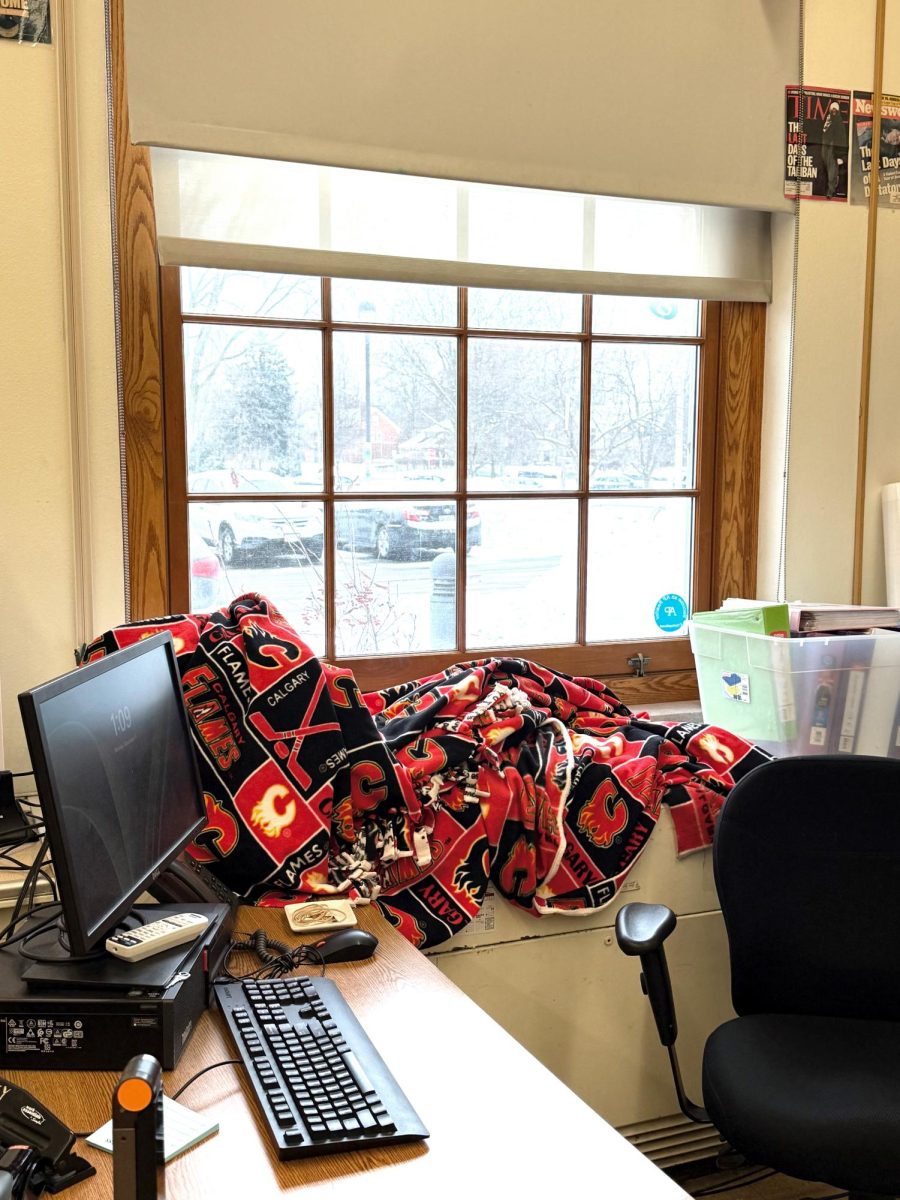
“Seventeen-degree outside air was blowing directly on me all day yesterday. My hands went numb while trying to use the computer at my work station,” said Grey, who draped a blanket over the heating vent. “I was also trying to keep the cold air from blowing onto students, who were asking to get their coats and complaining. I moved my classes after the room got progressively colder throughout the day.”
Grey said Room 161 had heat today during first period, but it didn’t last. “The fire alarm and heating oil rupture happened in the rooms on either side of me, so by fourth period, cold outside air was blowing in 161 again,” she said.
The effort to repair the coils in Room 158 created an aroma akin to burning tires, Grey said. “The entire 150s/160s hallway smelled as they tried to solder the heating coil, and it gave me an intense headache,” she said. “So, I moved my afternoon classes again today because of the cold and the smell.”
Stephens said classrooms will have heat tomorrow. “Heaters will arrive between 4-5 p.m. today. Classrooms will be warm tomorrow,” he said.
English teacher Kevin Callahan, who teaches in Room 153, where it was 58.1 degrees this morning, said that the heating system and repair process have been a problem for years. “Each year there seems to be one big repair, and it functions up until the next winter, when it breaks again,” he said.
Students said cold classroom temperatures disrupt learning. “The temperature has affected my learning extremely,” senior Mylo Jones said. “I can’t focus.”
Sophomore Eli Kestin said the district has to fix the problem. “It’s too cold to really pay attention in class,” he said.
Social studies teacher Bradley Bullard said the extreme temperatures aren’t a short-term issue, and they shouldn’t be treated as one. “I think that we’re putting a Band-Aid on something that needs stitches,” Bullard said.
Failure of the building’s systems are not the fault of the maintenance staff, Bullard said. “They know what they’re doing, and they have worked very hard to make sure that things get fixed,” he said.
Said Callahan, “I think if the district can’t fix its building, then they shouldn’t force students to be in the building.”
Raider Zone Reporters Ezra Epstein, Graham Gurney and Andrew Mullen, Copy Editor Claire Joyce and Opinion Writer Gabe Moulthrop contributed to this report. Photo Editor Cam Dozier compiled the photo gallery.